
Albuquerque Assault and Battery Lawyer
We Prosecuted These Cases. Now We Defend Them.


28+
years
of Combined Legal Experience
400+
Resolved Cases

Defending Assault and Battery Charges in Albuquerque
An arrest for assault or battery in Albuquerque puts your freedom, your job, and your future at risk. These charges move quickly through Bernalillo County courts, and prosecutors build their cases from day one.
Whether you acted in self-defense, were falsely accused, or the situation escalated beyond your control, every assault and battery case has defensible elements. We investigate witness statements, challenge police reports, review surveillance footage, and expose gaps in the prosecution's version of events. Your case deserves a defense built on facts, not assumptions.
Simple Assault Charges
New Mexico law defines assault as an attempt to commit battery or any threat or menacing conduct that makes someone reasonably believe they're about to be harmed. No physical contact is required.
Prosecutors file simple assault charges after bar altercations, heated arguments, workplace confrontations, or domestic disputes where threats were allegedly made. These charges are typically petty misdemeanors carrying up to six months in jail and $500 in fines, but a conviction still creates a criminal record that affects employment and housing.
We examine whether the alleged threat was actually communicated, whether the other person's fear was reasonable, and whether you intended to threaten anyone at all. Misunderstandings, exaggerated claims, and false accusations all create openings for your defense.
Simple Battery Charges
Battery occurs when someone intentionally touches or applies force to another person in a rude, angry, or insulting manner. The contact doesn't need to cause injury. Pushing someone during an argument, grabbing someone's arm to prevent them from leaving, or even throwing an object that makes contact can result in battery charges.
Simple battery is also typically charged as a petty misdemeanor with penalties of up to six months in jail and fines up to $500.
Defense often centers on intent. Did you mean to make contact, or was it accidental? Was the contact truly offensive or done in anger, or was it incidental during a chaotic situation? We challenge the prosecution's characterization of events and present alternative explanations that create reasonable doubt.
Aggravated Assault Charges
Aggravated assault becomes a fourth-degree felony in New Mexico when the assault involves the use of a deadly weapon or occurs under circumstances that show an intent to commit a violent felony.
Prosecutors also charge aggravated assault when the victim is a household member. Penalties jump to up to 18 months in prison and fines up to $5,000.
The presence of a weapon doesn't automatically mean aggravated assault. We scrutinize whether the object qualifies as a deadly weapon, whether you actually threatened anyone with it, and whether the prosecution can prove your intent. Many aggravated assault charges stem from overreactions by police or exaggerated victim statements that don't match physical evidence.
Aggravated Battery Charges
Aggravated battery occurs when battery results in great bodily harm or involves the use of a deadly weapon. This is a third-degree felony carrying up to three years in prison and fines up to $5,000.
Medical records, photographs, and expert testimony become critical. Prosecutors must prove the injuries were serious enough to qualify as "great bodily harm," which requires more than minor cuts or bruises.
We challenge medical records, question whether injuries were caused by the incident or pre-existed, and present alternative explanations for how injuries occurred. The state's burden of proof is high, and its evidence often contains holes we can exploit.

Assault with Intent to Commit a Violent Felony
When prosecutors believe an assault was committed with the intent to commit another violent crime, such as robbery, sexual assault, or murder, they charge it as a third-degree felony. Penalties include up to three years in prison and fines up to $5,000. These charges often rely on circumstantial evidence, witness speculation about your intentions, and the prosecution's interpretation of ambiguous facts.
Intent is difficult to prove. We force the state to demonstrate actual evidence of your alleged intent rather than allowing them to rely on assumptions, stereotypes, or the victim's subjective fears.
Assault or Battery on School Personnel, Healthcare Workers, or Sports Officials
New Mexico treats assaults and batteries against specific protected classes seriously. Charges involving teachers, school staff, nurses, doctors, emergency medical personnel, or sports officials receive enhanced penalties. Even misdemeanor-level conduct can be elevated to felony charges when the victim falls into one of these categories.
Defense often requires showing the alleged victim wasn't acting in their official capacity at the time, that you didn't know they held that position, or that the incident was accidental rather than intentional. These cases frequently arise from misunderstandings in high-stress medical or educational settings.
#cta_start
Every Case Has a Defense. Let's Find Yours.
Assault and battery charges don't convict themselves. Evidence gets challenged, witnesses contradict themselves, and police make mistakes. Your defense starts with a clear assessment of what the prosecution can actually prove. Contact us today to get started.
#cta_end
Penalties for Assault and Battery Convictions in Albuquerque
The penalties for assault and battery in New Mexico depend on the specific charge, whether the offense is classified as a misdemeanor or felony, and your criminal history. A conviction doesn't just mean jail time and fines; it creates a criminal record that affects employment, housing, professional licenses, and more.
Having an assault and battery lawyer in Albuquerque who knows how prosecutors pursue these cases gives you the strongest chance at avoiding conviction or reducing charges.
Judges also have discretion to impose probation, community service, anger management classes, restraining orders, and restitution payments. Even if you avoid jail, a conviction still appears on background checks and creates long-term obstacles.
The prosecutor doesn't get to decide your guilt. We challenge their evidence, cross-examine their witnesses, and force them to meet their burden of proof at every stage.
Collateral Consequences of an Assault or Battery Conviction
A conviction for assault or battery creates problems that extend far beyond your sentence. The criminal record follows you, affecting your ability to work, find housing, maintain professional credentials, and exercise basic rights.
Employment and Career Limitations
Employers conduct criminal background checks, and assault and battery convictions raise immediate red flags. Jobs in education, healthcare, finance, law enforcement, government positions, and roles involving vulnerable populations become difficult or impossible to obtain.
Current employers may terminate your employment upon learning of the conviction. Self-employment and contract work also suffer when clients conduct background screening.
Professional Licenses and Certifications
State licensing boards for nurses, teachers, real estate agents, contractors, lawyers, accountants, and other regulated professions review criminal convictions.
Assault and battery convictions, especially those involving violence, trigger disciplinary proceedings that can result in license suspension, revocation, or denial of renewal. Some professions impose mandatory reporting requirements that force you to disclose convictions immediately.
Housing and Rental Applications
Landlords routinely reject applicants with violent crime convictions, even misdemeanors. Property management companies use automated screening that flags assault and battery charges before a human ever reviews your application. This limits your housing options and forces you into less stable living situations or areas with higher costs.
Firearm Rights
Felony assault or battery convictions trigger firearm prohibitions. You lose the right to own, possess, or purchase firearms. Careers in law enforcement, private security, military service, and hunting-related industries become inaccessible. Restoration of firearm rights requires separate legal proceedings and is not guaranteed.
Immigration Consequences
Non-citizens face deportation, visa denial, or permanent inadmissibility following assault and battery convictions. Immigration authorities may classify these offenses as crimes involving moral turpitude or crimes of violence.
Lawful permanent residents can be placed in removal proceedings, visa applicants may be denied entry, and even temporary visitors risk being barred from future U.S. travel.
Child Custody and Parenting Time
Family courts consider assault and battery convictions, particularly those involving domestic violence or household members, when making custody and visitation decisions. You may face supervised visitation requirements, restricted parenting time, or loss of decision-making authority regarding your children. The conviction becomes evidence against you in any custody dispute.
Educational Opportunities
Colleges and universities ask about criminal history on applications. Assault and battery convictions can result in denial of admission, loss of financial aid eligibility, or dismissal from academic programs. Professional graduate programs in medicine, law, and teaching scrutinize violent crime convictions closely and often deny admission based on them.
Common Defenses to Assault and Battery Charges
Every assault and battery case is defensible. The prosecution must prove every element beyond a reasonable doubt, and its evidence often contains weaknesses, inconsistencies, and gaps that an experienced criminal defense attorney can exploit.
Self-Defense
You have the right to use reasonable force to protect yourself from immediate harm. Self-defense applies when you reasonably believed you were in danger, used force proportional to the threat, and didn't provoke the confrontation.
We may be able to present evidence showing you acted in response to aggression, not as the initial aggressor. New Mexico law doesn't require you to retreat before defending yourself in places where you have a legal right to be.
Defense of Others
Similar to self-defense, you can use reasonable force to protect another person from immediate harm. This defense applies when you reasonably believe someone else faced danger and your actions were necessary to prevent harm. If applicable, we establish that you witnessed a threat and responded appropriately to protect a third party.
False Accusation or Mistaken Identity
Many assault and battery charges stem from false accusations made during domestic disputes, custody battles, or situations where the alleged victim has a motivation to lie. Others result from mistaken identification in chaotic situations like bar fights or street altercations.
We investigate the accuser's credibility, motivation to fabricate, and inconsistencies in their statements. Surveillance footage, witness testimony, and alibi evidence may prove you weren't the person who committed the alleged act.

Lack of Intent
Assault and battery charges require intentional conduct. Accidental contact, actions taken during consensual activity, or movements made without awareness don't meet the legal definition. We may be able to demonstrate that any contact was unintentional, that you lacked the required mental state, or that the prosecution cannot prove you acted deliberately.
Consent
In certain contexts, like contact sports, martial arts training, rough play, or consensual physical activities, participants agree to contact that would otherwise constitute battery. We’ll build a case to show that both parties understood and accepted the possibility of physical contact as part of the activity.
Insufficient Evidence
The prosecution must prove every element of the charge beyond a reasonable doubt. When evidence is weak, contradictory, or relies solely on the alleged victim's word without corroboration, we attack the insufficiency directly. Many cases come down to "he said, she said" scenarios where reasonable doubt is easy to establish.
Violation of Constitutional Rights
Evidence obtained through illegal searches, coerced statements, or violations of your Miranda rights cannot be used against you. We file motions to suppress evidence when police exceeded their authority, conducted searches without warrants or probable cause, or interrogated you after you invoked your right to counsel.
Why Choose Peake Law Firm for Your Assault and Battery Defense?
Our clients rely on our thorough approach and individualized case strategies to build strong defenses on their behalf. When you hire Peake Law Firm, you can benefit from our experience and dedication.
Former Prosecutor's Insight
Jonathan Peake handled violent crime cases as a prosecutor and knows how the state builds assault and battery prosecutions. That inside knowledge becomes your advantage in identifying weaknesses and dismantling their case.
Immediate Case Investigation
We review police reports, interview witnesses, obtain surveillance footage, and preserve evidence before it disappears, moving quickly from the moment you contact us.
English or Spanish Communication
We provide clear legal guidance in English or Spanish, ensuring you fully understand the charges against you, your options, and the defense strategy. No legal jargon. No vague reassurances.
Bernalillo County Court Experience
We handle assault and battery cases in Bernalillo County courts regularly, with direct familiarity with local prosecutors, judges, and courtroom procedures that shape case outcomes.
Realistic Case Assessment
You get honest answers about your case from day one. We don't promise outcomes we can't deliver. We tell you what the evidence shows, what the prosecution has, and what your real options are.
Facing Assault or Battery Charges? Your Defense Starts Now.
An assault or battery conviction in Albuquerque can mean jail time, fines, and a criminal record that follows you for life. Jonathan M. Peake spent years handling criminal cases as a prosecutor and now uses that inside knowledge to defend clients facing these charges.
What Albuquerque Clients Say About Their Defense
Jonathan M. Peake: Prosecutor Experience Working for Your Defense
Albuquerque Assault and Battery Attorney | Former Prosecutor
Jonathan Peake built his criminal law practice on direct courtroom experience, not theory. As a former prosecutor, he filed assault and battery charges, argued for convictions, and saw firsthand how these cases succeed or fail. Now he uses that knowledge to dismantle the prosecution's case from the inside, finding the weaknesses that prosecutors hope defense attorneys won't notice.



Assault and Battery Defense Across Albuquerque and Central New Mexico
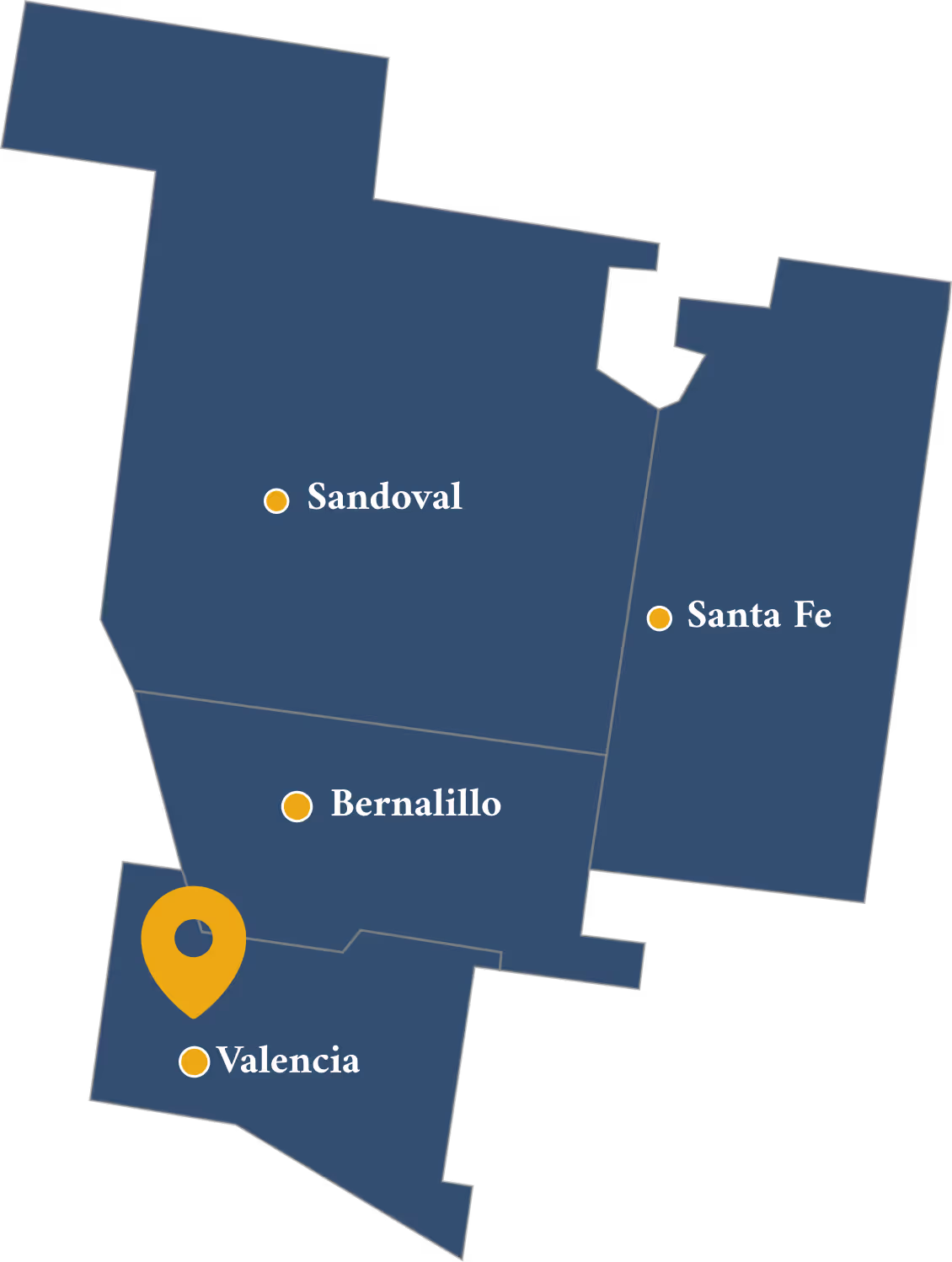
We represent clients throughout Albuquerque and the surrounding areas, including cases before the Bernalillo County Metropolitan Court and Second Judicial District Court. Learn more about where we serve throughout central New Mexico.
Our Office:
Office Location: 1100 4th St NW, Suite A Albuquerque, NM 87102
Phone: (505) 750-7702
Email: [email protected]

Start Your Defense with a Straight-Talk Consultation
Meet a former prosecutor with criminal law experience in New Mexico courts. Get direct answers, a realistic case assessment, and a defense strategy built around the specific facts of your charges. We give you the truth about your case from day one.
Assault and Battery Questions Answered
What's the difference between assault and battery in New Mexico?
Assault is an attempt to commit battery or threatening conduct that makes someone reasonably fear immediate harm. No physical contact is required. Battery is the actual intentional touching or application of force to another person in an offensive manner. You can be charged with both if you threatened someone and then made physical contact.
Can assault charges be filed even if I never touched anyone?
Yes. New Mexico law allows assault charges based solely on threats or menacing conduct that makes someone reasonably believe they're about to be harmed. The prosecution doesn't need to prove physical contact occurred — only that you attempted battery or engaged in threatening behavior.
What makes assault or battery "aggravated" in New Mexico?
Assault or battery becomes aggravated when it involves a deadly weapon, results in great bodily harm, or is committed with the intent to commit another violent felony. Charges are also enhanced when the victim is a household member, school personnel, healthcare worker, or sports official. Aggravated charges are felonies carrying significantly higher penalties than simple assault or battery.
Can I claim self-defense if I was arrested for assault or battery?
Yes, if you reasonably believed you faced immediate harm and used proportional force to protect yourself. New Mexico law allows self-defense without a duty to retreat in places where you have a legal right to be. We present evidence showing you responded to aggression rather than initiating the confrontation.
What if the other person started the fight?
If the alleged victim was the initial aggressor, your self-defense claim may be strengthened. We investigate who made the first threat, who initiated physical contact, and whether you acted to protect yourself. Witness statements, surveillance footage, and physical evidence help establish who started the confrontation.
Will an assault or battery conviction affect my job?
Most likely. Employers conduct background checks, and violent crime convictions create barriers to employment, especially in education, healthcare, finance, government, and positions involving vulnerable populations. Current employers may terminate you upon learning of the conviction. Professional licenses may be suspended or revoked.
Can assault or battery charges be dropped?
Yes. Charges can be dismissed when the prosecution lacks evidence, when we expose false accusations or mistaken identity, when constitutional rights were violated, or when we negotiate with prosecutors before trial. No attorney can guarantee dismissal, but thorough investigation and strong defense advocacy increase those chances significantly.
What happens if I'm convicted of a felony assault or battery charge?
Felony convictions carry prison time, substantial fines, probation, and a permanent criminal record. You'll lose firearm rights, face employment and housing discrimination, risk losing professional licenses, and may experience immigration consequences if you're not a U.S. citizen. Child custody proceedings will also be affected negatively.
Do I need a lawyer for a misdemeanor assault or battery charge?
Absolutely. Even misdemeanor convictions create criminal records that affect employment, housing, and your future. The penalties include jail time, fines, probation, and collateral consequences that last for years beyond your sentence. An experienced assault and battery attorney in Albuquerque can often get charges reduced or dismissed entirely.
Can I be charged with assault and battery at the same time?
Yes. If you threatened someone (assault) and then made physical contact (battery), prosecutors can charge both. Many cases involve both charges arising from the same incident. Your attorney can challenge whether the prosecution can prove both offenses or argue for the consolidation of charges.
What should I do if I'm arrested for assault or battery?
Remain silent and request an attorney immediately. Don't explain what happened to the police, don't try to justify your actions, and don't sign any statements. Police will use anything you say to build their case against you. Contact a criminal defense attorney before speaking to anyone about the incident.
How long does an assault or battery case take in Albuquerque?
Misdemeanor cases typically resolve within a few months, while felony cases can take six months to over a year, depending on complexity, evidence disputes, and whether the case goes to trial. Some cases resolve quickly through plea negotiations, while others require extensive investigation and pretrial motions before resolving.