How to Get a DWI Dismissed in New Mexico
Updated:
29/6/2026
Table of Contents
In New Mexico, it’s possible for a DWI charge to be dismissed when the state can’t legally use key evidence or prove every part of the charge. The strongest strategies focused on achieving dismissal usually attack the stop, the officer’s reasons for starting a DWI investigation, the arrest, the subsequent chemical testing, or missing or questionable evidence.
At Peake Law Firm, our skilled DWI attorneys know how to review the evidence, challenge weak police work, protect clients’ driving privileges, and find the best route to dismissal, reduction, or a successful trial defense. While a DWI dismissal is never guaranteed, many cases have legal weaknesses that can be exploited to overcome the charge.
Quick Answer
A DWI may be dismissed in New Mexico if the defense can prove any of the following:
- The traffic stop was unlawful.
- The officer lacked reasonable suspicion.
- The arrest lacked probable cause.
- The breath or blood test result is unreliable.
- The state can’t prove driving or actual physical control.
- The prosecutor lacks the evidence needed for trial.
It takes a skilled criminal defense attorney to point out these flaws in the prosecution’s case and take the necessary steps to secure a dismissal.
Your DWI Court Case and License Case Are Separate
.webp)
In New Mexico, a DWI court case and a judicial license-revocation case proceed on separate tracks. As such, a criminal DWI dismissal doesn’t automatically get your license out of jeopardy.
The state has the authority to revoke a driver’s license through both the Implied Consent Act and a conviction for DWI in criminal court. The Implied Consent Act hearing is also separate from the criminal case.
Here’s what that means:
- The court case decides guilt, penalties, and criminal record issues.
- The MVD case decides whether your driving privileges are revoked.
- The MVD hearing can be problematic even if your criminal case looks defensible.
- The MVD hearing can produce testimony that helps your criminal defense.
Drivers usually must request an MVD hearing within 10 days of receiving a Notice of Revocation.
What Happens After a DWI Arrest in New Mexico?
DWI cases tend to move quickly after the initial arrest. The criminal case may begin with an arraignment, while the MVD license case proceeds on its own deadline. Don’t make the mistake of treating the first court date as the only urgent issue.
Here are the key steps you can expect in your case:
- The arraignment, where the charge will be read, and you’ll enter a plea;
- The MVD hearing deadline, which can affect your driving privileges;
- The discovery phase, where your lawyer will review police reports, video footage, and testing records;
- The first review of whether the complaint, stop, arrest, or testing has legal defects;
- The decision whether to negotiate, file motions, or prepare for trial.
You shouldn’t plead guilty before the evidence has been fully reviewed. A case that looks bad in the police report may prove to have testing errors, legality issues, or missing proof.
An Unlawful Stop Can Get DWI Evidence Thrown Out
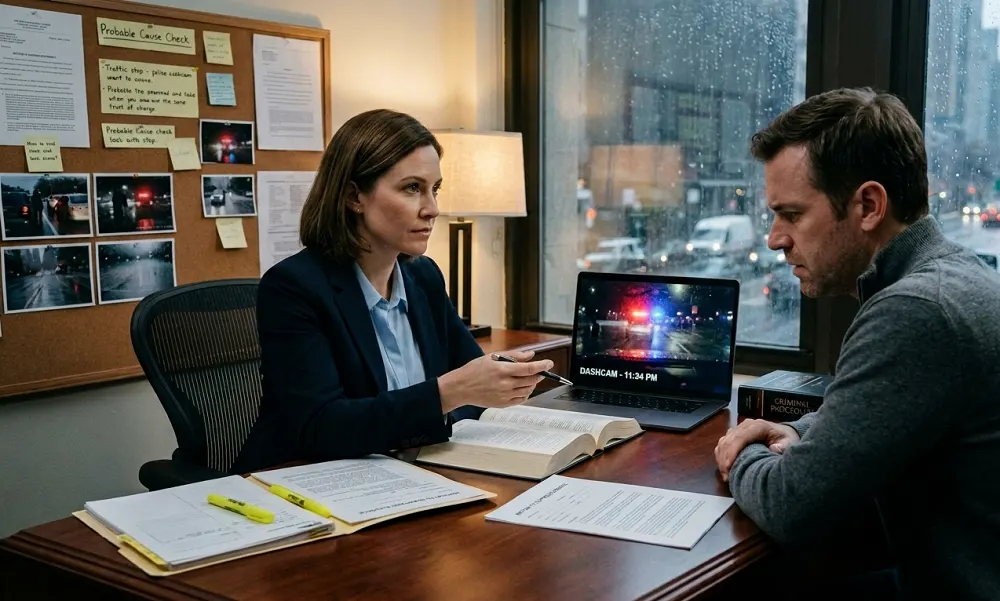
Your DWI case may be dismissed if the initial police stop was illegal, which means the state loses the evidence gathered during and afterward. Law enforcement personnel need a lawful reason to pull someone over. A vague suspicion that a driver might be impaired isn’t enough.
Your DWI attorney might focus on any of the following when building your defense:
- The alleged traffic violation;
- The officer’s body camera footage;
- The dash camera footage (if available);
- The dispatch notes;
- The wording of the citation;
- The officer’s reported reason for the stop;
- Weather, lane markings, lighting, and traffic conditions.
If the officer says you crossed a line, but the video doesn’t show it, it could undermine the prosecution’s case.
Similarly, your defense lawyer can ask the judge to suppress the evidence if it comes to light that the stop was unconstitutional. If the suppressed evidence is central to the state’s case, dismissal may follow.
A Traffic Stop Needs a Legal Reason to Become a DWI Investigation
A driver can be legally stopped for speeding, having expired tags, or another traffic issue, but that doesn’t automatically give the officer grounds to commence a DWI investigation. There needs to be specific facts that point to impairment.
This exact issue led to dismissal in City of Santa Fe v. Marquez. The illegally obtained evidence was suppressed, and the defendant’s charge was dismissed after the court found that the officer lacked reasonable suspicion to expand the traffic stop into a DWI investigation.
Facts that can weaken an officer’s claim of reasonable suspicion include:
- Clear speech;
- Steady balance;
- Cooperative behavior;
- No visual confirmation or odor of alcohol;
- No bad driving beyond the reason for the initial stop;
- No admission of intoxication beyond a small amount of alcohol;
- Video footage that contradicts the police report.
The officer’s version of events isn’t the final word. Any of the evidence they collect to use against you could prove to be pivotal in having your case thrown out.
#cta_start
Don’t Give the Prosecution a Head Start
An unlawful stop, weak probable cause, or an unreliable breath test may open the door to evidence suppression or complete case dismissal. Trust Peake Law Firm to review the evidence against you before you decide what to do next.
#cta_end
Getting Evidence Suppressed in a DWI Case
Probable cause is the legal line between a DWI investigation and an arrest, and the responding officer must have certain facts before detaining you. A positive breath or blood result obtained later on doesn’t automatically vindicate an unjustified arrest.
When you hire an attorney, they’ll review the following points relating to probable cause:
- What the officer knew and observed before the arrest.
- Whether field sobriety tests were administered correctly.
- Whether you have any medical or balance issues.
- Whether your speech, gait pattern, and behavior were normal.
- Whether the police report interpolates details not shown on video.
- Whether the officer ignored facts that pointed away from impairment.
Field sobriety tests, in particular, call for careful scrutiny. Our seasoned lawyers know how to zero in on the procedural errors and oversights that can break the state’s case.
Possible Issues with Breath and Blood Testing

A score on a breath or blood test isn’t enough in itself for prosecutors to secure a conviction. They must also show that the test was legally justified, administered correctly, and reliable enough to hold up in court.
Aspects of a breath test worth checking include:
- Operator certification;
- Machine certification;
- Observation period;
- Mouth alcohol concerns;
- Calibration records;
- Maintenance records;
- Testing sequence;
- Missing logbook entries;
The points of interest in a blood test include:
- Whether there was a warrant or a legal exception;
- The blood-draw procedure;
- Labeling;
- Chain of custody;
- Storage;
- Lab-testing method;
- Analyst availability;
- The time gap between driving and testing.
If the state can’t show that every step of testing was carried out properly, the judge may exclude it. Without these results, DWI cases become much harder to prove.
The State Must Prove You Drove or Controlled the Vehicle

Your DWI case could also be dismissed if the prosecution can’t prove you were driving or in actual physical control of your vehicle with the intent to drive. This obstacle may be present if you were sitting or sleeping in a parked car or had just been involved in an accident that wasn’t your fault, or if the police arrived after the alleged driving.
In State v. Sims, the New Mexico Supreme Court ruled that a DWI conviction based on actual physical control requires proof that the defendant controlled the vehicle and had general intent to drive in a way that posed a real danger. Here are some of the facts the state will need to establish in your case:
- Where the keys were;
- Whether the engine was running;
- Whether the vehicle was parked safely;
- Whether you were asleep;
- Whether anyone saw you driving;
- Whether another person had driven the vehicle;
- Whether the vehicle could move.
Again, evidence of impairment alone isn’t enough. If prosecutors can’t prove you were driving or in actual physical control, dismissal may be an option.
Missing Evidence or Witnesses Can Create a Defense Opportunity
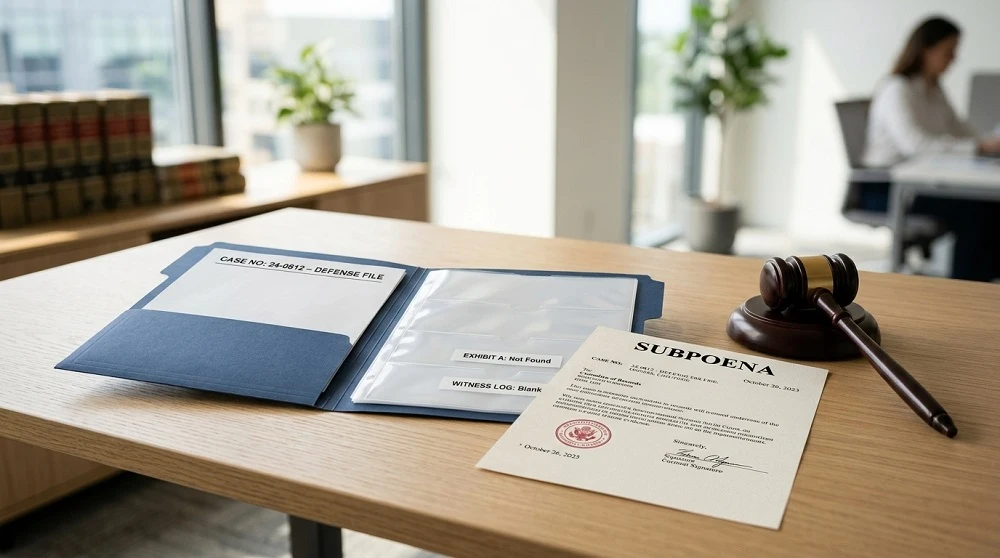
DWI cases often rely on witness testimony and records like video footage, testing results, and lab documents. If the state can’t produce them, the defense may have a strong motion for dismissal.
The rules of the Administrative Hearings Office allow subpoenas for witnesses and records in Implied Consent Act hearings, and failure to comply with a subpoena can affect the office’s ruling in your case.
With that in mind, you and your attorney should focus on requesting and presenting the following evidence:
- Body camera video;
- Dash camera video;
- Dispatch audio;
- Testing video;
- Booking video;
- Breath machine records;
- Blood draw records;
- Lab reports;
- Chain-of-custody records;
- Officer notes;
- Witness names.
Missing evidence doesn’t always mean automatic dismissal, but it can support suppression, sanctions, trial limits, or a stronger negotiating position.
Steps to Take After a DWI Arrest in New Mexico

If you’ve been charged with DWI, it’s imperative to act quickly, as evidence can disappear in a matter of days or weeks, and license deadlines can pass before you realize it. The idea is to do everything you can to protect yourself before your case becomes harder to defend.
Here are the most important steps to prioritize after your arrest:
- Request your MVD hearing within the 10-day deadline.
- Save the Notice of Revocation.
- Don’t plead guilty before meeting with an attorney.
- Write down the details of the stop, arrest, and testing.
- Save all relevant receipts, records, and communications.
- Ask for statements from witnesses while their memory is fresh.
- Tell your defense attorney about any medical issues you have.
- Request video footage, lab records, and officer notes from the police.
Getting a DWI dismissed doesn’t come down to luck. It comes from finding the weak link in the legal process and using it to derail the prosecution’s case.
Before You Plead, Put the Evidence to the Test
A DWI charge can affect your driving privileges, criminal record, employment and housing options, and future prospects. You need a capable criminal defense attorney to protect your rights and help you beat the state’s accusations.
Peake Law Firm can pursue the strongest available route toward dismissal, evidence suppression, charge reduction, or trial defense in your situation. Contact our team today to discuss your New Mexico DWI case.

Criminal Defense Attorney
Jonathan Peake is the founder and managing attorney of Peake Law Firm in Albuquerque, New Mexico. He is ready to build aggressive, strategic defenses for clients facing criminal charges.
Your Best Defense Starts with a Review of the Evidence
Prosecutors have to prove their case against you. The attorneys at Peake Law Firm can review the evidence to identify grounds for dismissal.

%20(1).avif)